iasiscare
Same-Day Primary Care vs Urgent Care: What’s the Difference?
Same-Day Primary Care vs Urgent Care: What’s the Difference?
When something feels wrong with your health, it can be hard to know where to go first. Should you call your primary care doctor? Should you go to urgent care? Should you wait it out? Or is it serious enough for the emergency room?
This is a common problem for patients, especially when their primary care doctor is booked for weeks. Many people end up using urgent care because it feels like the only option available. Urgent care can be helpful, but it is not always the best place for every health concern.
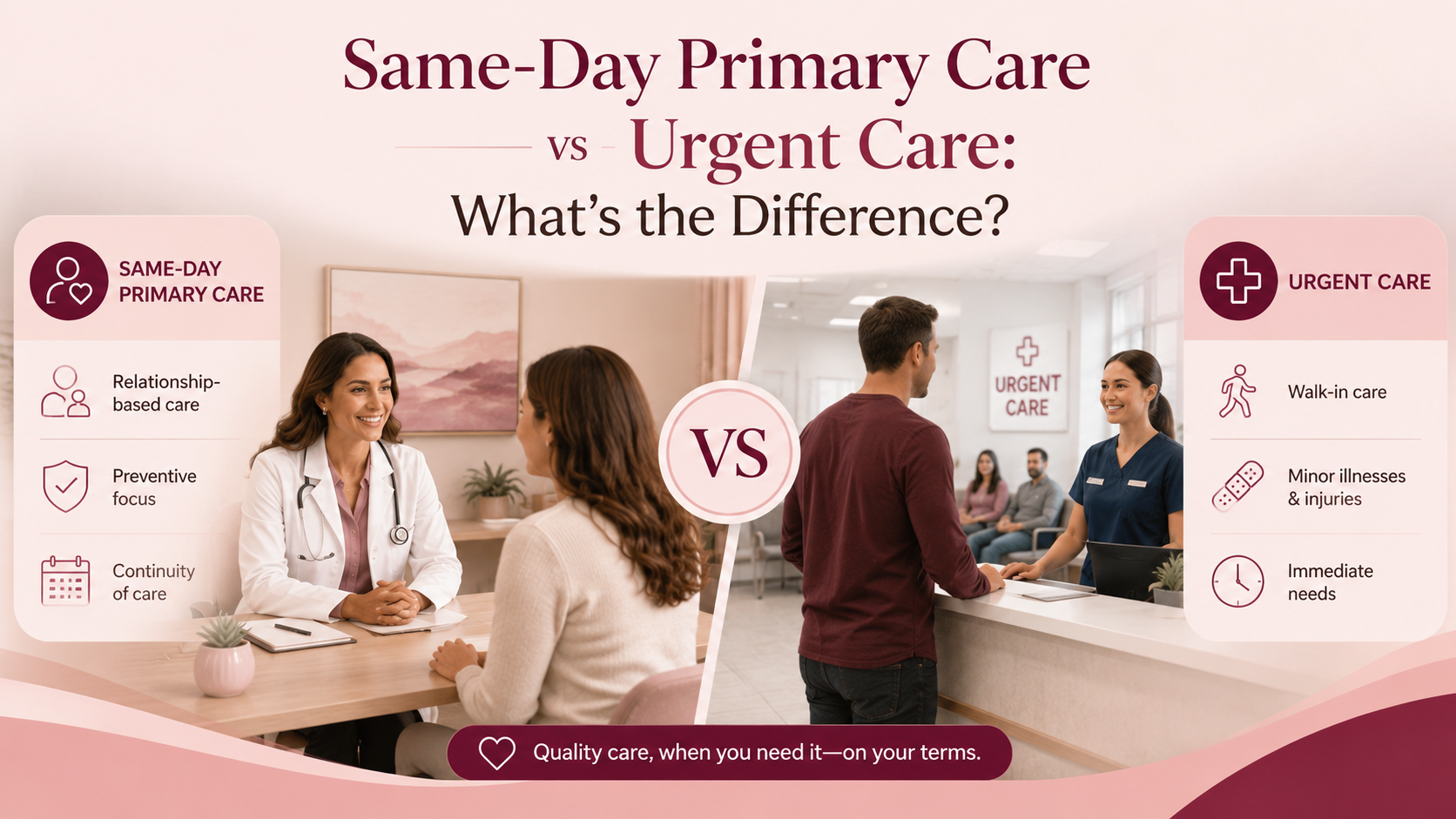
The biggest difference is this: urgent care is built to handle immediate, non-life-threatening problems, while same-day primary care is built to treat the immediate concern while also understanding your full health history.
At IASIS Boutique Health, Dr. Georgios Karanastasis provides concierge primary care with same-day and next-day availability for members, longer visits, direct physician access, and telehealth when appropriate. For many patients in Orland Park, Chicago, and the surrounding suburbs, this can help reduce unnecessary urgent care visits and create a stronger long-term healthcare relationship.
Quick Answer: Same-Day Primary Care vs Urgent Care
Same-day primary care is usually best when you want care from a doctor who knows your medical history, medications, chronic conditions, lab results, and long-term health goals.
Urgent care is usually best for sudden, non-life-threatening problems when your regular doctor is unavailable and the issue should not wait.
Both options can be useful. The right choice depends on your symptoms, how serious they are, and whether the issue needs one-time treatment or ongoing follow-up.
What Is Same-Day Primary Care?
Same-day primary care means you can be seen by your primary care doctor quickly, often the same day or next day, when a health concern comes up. This is different from the traditional primary care experience where the next available appointment may be several weeks away.
Same-day primary care is especially valuable because your doctor already has context. They know your medical history, current medications, risk factors, previous lab results, and what has been happening with your health over time.
Same-day primary care may be helpful for:
- New symptoms that are concerning but not life-threatening
- Blood pressure concerns
- Blood sugar concerns
- Medication side effects or medication questions
- Follow-up after urgent care
- Follow-up after an emergency room visit
- Respiratory symptoms that need medical guidance
- Minor infections
- Ongoing fatigue
- Worsening chronic conditions
- Lab review and care plan changes
- Questions about whether symptoms need urgent care or emergency care
For IASIS members, same-day and next-day access is part of the concierge medicine model. That means patients can often start with their physician instead of guessing where to go.
Learn more about our primary care model here: Concierge Primary Care in Orland Park.
What Is Urgent Care?
Urgent care is designed for health problems that need prompt attention but are not life-threatening emergencies. Urgent care centers are often helpful when your doctor is unavailable and you need to be seen quickly for a short-term issue.
Urgent care may be appropriate for:
- Cold or flu symptoms
- Sore throat
- Ear pain
- Minor cuts
- Minor burns
- Sprains
- Minor injuries
- Rashes
- Urinary symptoms
- Minor eye irritation
- Simple infections
Urgent care is not bad. It has an important purpose. The problem is when patients are forced to use urgent care for issues that would be better handled by a primary care doctor, simply because they cannot get an appointment.
If your regular doctor is always booked, you may want to read: What to Do When Your Primary Care Doctor Is Booked for Weeks.
5 Key Differences Between Same-Day Primary Care and Urgent Care
1. Same-Day Primary Care Knows Your Medical History
The biggest difference between primary care and urgent care is continuity.
At urgent care, the provider may be seeing you for the first time. They may not know your full medical history, allergies, medications, recent lab results, chronic conditions, previous specialist visits, or long-term health goals.
That may be fine for a simple sore throat or minor injury. But for anything more complicated, your history matters.
For example, if you have high blood pressure, diabetes, thyroid disease, high cholesterol, kidney concerns, heart risk factors, or multiple medications, your symptoms may need more context. A primary care physician who knows you can often make better decisions because they understand the bigger picture.
This is especially important for patients managing long-term conditions. If that applies to you, read more here: Concierge Medicine for Chronic Conditions.
2. Urgent Care Usually Focuses on the Immediate Problem
Urgent care is usually focused on the reason you came in that day. That can be helpful when the problem is simple and short-term.
For example, urgent care can be useful if you have an earache, a sore throat, a mild injury, a rash, or a minor cut. The goal is usually to evaluate the immediate concern and give short-term treatment or next steps.
Same-day primary care can also address the immediate concern, but it can go deeper. Your doctor can ask:
- Has this happened before?
- Could this be related to a medication?
- Do your lab results show a pattern?
- Is your blood pressure changing?
- Does this connect to another condition?
- Do we need to adjust your long-term care plan?
- Should we follow up again soon?
That extra layer matters because many health concerns are not isolated. They may connect to your medications, lifestyle, chronic conditions, stress, sleep, hormones, cardiovascular risk, or other factors.
3. Same-Day Primary Care Can Help Prevent Unnecessary Urgent Care Visits
Many patients go to urgent care because they do not know what else to do.
They may have a primary care doctor, but the next opening is weeks away. They may call the office and be directed to a portal. They may not know whether their symptoms are serious. They may not want to wait and hope things improve.
This is where access becomes a major part of healthcare quality.
When patients have same-day or next-day access to a primary care physician, they can often get guidance earlier. Sometimes they need an office visit. Sometimes a telehealth visit is appropriate. Sometimes urgent care is the right choice. Sometimes the emergency room is necessary.
The difference is that the patient is not left guessing alone.
This is one of the reasons patients consider concierge medicine. The model is built around better access, more time, and a stronger physician relationship. You can learn more here: Benefits of Concierge Medicine.
4. Primary Care Is Better for Prevention and Follow-Up
Urgent care can treat a problem today, but it may not fully close the loop.
For example, you might go to urgent care for high blood pressure and be told to follow up with your doctor. You might go for dizziness and be told to monitor symptoms. You might go for a recurring infection and receive treatment, but not a deeper review of why the problem keeps happening.
Primary care is where those follow-ups should happen.
A strong primary care relationship helps with:
- Annual physicals
- Lab review
- Blood pressure monitoring
- Cholesterol management
- Blood sugar and diabetes prevention
- Medication adjustments
- Preventive screenings
- Cardiovascular risk assessment
- Chronic condition care plans
- Long-term health goals
At IASIS Boutique Health, annual comprehensive labs, EKG testing, point-of-care testing, office visits, telehealth, and direct physician access are included in the membership.
For a deeper look at what this model includes, read: What Does a Concierge Doctor Do?.
5. Urgent Care Does Not Replace a Doctor-Patient Relationship
Urgent care can be helpful, but it does not replace a long-term doctor-patient relationship.
A primary care doctor is not just someone you see when you are sick. Your doctor should help you understand your numbers, prevent future problems, monitor risk factors, coordinate care, adjust medications, and make health decisions with you over time.
That kind of relationship is hard to build in one-time urgent care visits.
This is where concierge medicine is different from traditional rushed care. With a smaller patient panel, longer visits, and more direct access, Dr. Karanastasis is able to provide a more personal primary care experience for patients who want stronger continuity.
If you are comparing traditional care and concierge care, this guide may help: Concierge Doctor vs. Primary Care.
When Should You Use Urgent Care?
Urgent care may be a good option when the issue is not life-threatening but should be evaluated soon, especially if your primary care doctor is unavailable.
Examples may include:
- Minor cuts or burns
- Sprains or minor injuries
- Ear pain
- Sore throat
- Cough or cold symptoms
- Flu-like symptoms
- Mild fever
- Rashes
- Urinary symptoms
- Minor eye irritation
- Simple infections
Urgent care is meant to help fill the gap between routine doctor visits and emergency care. It can be very useful when the issue is short-term, fairly straightforward, and not life-threatening.
When Should You Go to the Emergency Room?
Go to the emergency room or call emergency services if symptoms may be life-threatening or severe.
This may include:
- Chest pain
- Trouble breathing
- Stroke-like symptoms
- Fainting
- Sudden confusion
- Severe weakness
- Severe abdominal pain
- Severe allergic reaction
- Heavy bleeding
- Severe burns
- Major injury
- Head injury
- Sudden trouble speaking, seeing, walking, or moving
This article is for general education and is not a substitute for medical advice. If symptoms feel severe, sudden, or dangerous, seek emergency care immediately.
When Same-Day Primary Care May Be the Better First Step
Same-day primary care may be the better first step when the issue is not clearly an emergency and you want your own physician involved.
This may include:
- A new symptom you are worried about
- A chronic condition that feels less controlled
- Medication questions
- Blood pressure concerns
- Blood sugar concerns
- Lab result questions
- Follow-up after urgent care
- Follow-up after an ER visit
- Ongoing fatigue
- Recurring infections
- Preventive care planning
- Health changes that need context
With concierge medicine, patients do not have to wait weeks just to begin the conversation.
What Is Included in an IASIS Boutique Health Membership?
At IASIS Boutique Health, concierge medicine is designed to make primary care easier to access, more personal, and more complete. Instead of paying a membership fee and still feeling rushed, members receive more time with Dr. Karanastasis and more direct access when questions or concerns come up.
Membership includes:
- Unlimited office visits for included primary care services
- Annual comprehensive labs to help monitor your overall health
- Unlimited telehealth visits when virtual care is appropriate
- EKG testing for heart and cardiovascular screening when needed
- Point-of-care testing for certain in-office health concerns
- Direct access to Dr. Karanastasis
- No copays for included services
- Same-day and next-day appointment availability for members
The individual membership is $209 per month or $2,500 annually. The family plan is $4,000 per year for two adults.
This is one of the biggest differences between concierge medicine and traditional primary care. The goal is not just to get an appointment faster. The goal is to build a stronger doctor-patient relationship where your physician has time to understand your health, follow up properly, and help you make better long-term decisions.
Read more here: Is Concierge Medicine Worth It?.
Same-Day Primary Care and Telehealth
Not every concern requires an in-office visit.
Telehealth can be useful for certain follow-ups, medication questions, lab reviews, care-plan conversations, and symptoms that can be safely evaluated virtually. For patients across Orland Park, Chicago, Hinsdale, Burr Ridge, Western Springs, Clarendon Hills, Oak Brook, Naperville, and surrounding suburbs, telehealth can make access easier while still keeping care connected to the physician.
At IASIS Boutique Health, telehealth is included in every membership when appropriate.
For patients who live farther away from the office, this can make concierge care more practical without losing the relationship-based model.
Who Benefits Most from Same-Day Primary Care?
Same-day primary care can be especially valuable for:
- Busy professionals
- Adults with chronic conditions
- Patients taking multiple medications
- Patients who want stronger preventive care
- Older adults who need closer monitoring
- Families who want a trusted physician relationship
- Patients frustrated by long appointment waits
- Patients who want direct access instead of portal-only communication
- Patients who prefer a private, calm, personalized care model
This is one reason concierge medicine is appealing to many patients in Chicago’s suburbs. It gives primary care enough time and access to actually function the way patients expect it to.
Helpful related guides:
Who Should Get a Concierge Doctor?
Why Pay for Concierge Medicine?
Final Thoughts: Urgent Care Is Helpful, But It Should Not Be Your Only Access Point
Urgent care has an important role. It can help when a problem is sudden, non-life-threatening, and your doctor is not available.
But urgent care should not become your default primary care plan.
If you constantly have to choose between waiting weeks or going to urgent care, the real issue may be access. Same-day primary care gives patients a better option: a physician who knows them, has time for them, and can help manage both the immediate concern and the bigger health picture.
At IASIS Boutique Health, Dr. Georgios Karanastasis provides concierge medicine for patients who want more direct access, longer visits, preventive care, chronic condition management, and a stronger doctor-patient relationship.