iasiscare
What Is an Executive Physical? A Complete Guide
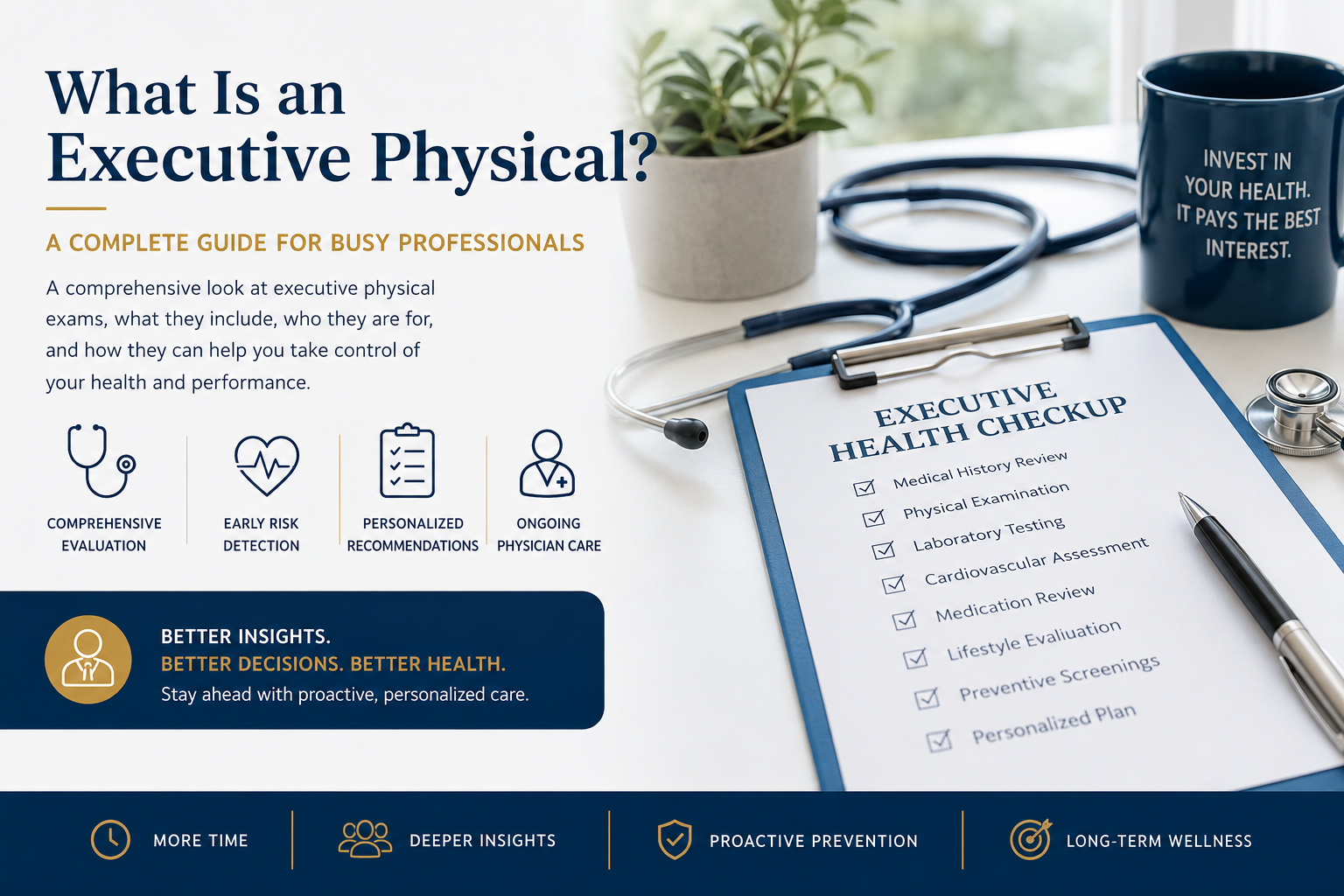
What Is an Executive Physical? A Complete Guide for Busy Professionals
An annual physical is supposed to help you understand your health. But for many busy professionals, a traditional checkup can feel surprisingly brief.
You arrive. Your blood pressure is checked. Your doctor reviews a few questions. Routine laboratory testing may be ordered. Then you are back to work.
An executive physical takes a more comprehensive approach.
Rather than looking only at how you feel today, an executive health evaluation is designed to take a broader look at your medical history, current health, medications, risk factors, preventive care needs, lifestyle and long-term wellness.
The goal is not to order every test available or search for rare diseases.
The goal is to answer a much more useful question:
What deserves your attention now so you can make better decisions about your health over the next 5, 10 or 20 years?
This guide explains what an executive physical is, what may be included, how it differs from a regular annual physical, who may benefit from one and how to prepare for a more comprehensive health evaluation.
Quick Answer: What Is an Executive Physical?
An executive physical is a comprehensive preventive health evaluation designed to give a patient a deeper understanding of their current health, potential risk factors and future preventive care needs.
Depending on your age, medical history, symptoms, medications, family history and individual risk factors, an executive health exam may involve:
- A detailed medical history
- A comprehensive physical examination
- Blood pressure and vital signs
- Laboratory testing when appropriate
- Cardiovascular risk assessment
- Blood sugar and diabetes risk evaluation
- Cholesterol review
- Medication and supplement review
- Family medical history
- Preventive screening review
- Nutrition and physical activity discussion
- Sleep and stress assessment
- Personalized recommendations
- A clear follow-up plan
There is no single test package that defines an executive physical. A thoughtful evaluation should be personalized to the individual rather than automatically giving every patient the same tests.
Patients in the Chicago suburbs who are interested in this type of comprehensive preventive approach can learn more about executive healthcare in Orland Park.
Executive Physical vs. Regular Annual Physical
One of the easiest ways to understand executive healthcare is to compare it with a standard annual physical.
| Regular Annual Physical | Executive Physical |
|---|---|
| General preventive checkup | More comprehensive preventive evaluation |
| Routine medical history review | More detailed medical and family history review |
| Physical examination | Physical examination with broader risk discussion |
| Routine testing when appropriate | Potentially broader individualized laboratory evaluation |
| Preventive screening review | More detailed preventive and risk assessment |
| May have limited time for lifestyle discussion | Greater opportunity to discuss sleep, stress, nutrition and exercise |
| Follow-up may require another appointment | Greater emphasis on interpreting results and creating a follow-up plan |
A regular annual physical can still provide excellent preventive care. The difference is usually the time, depth, convenience, coordination and personalization of the evaluation.
If you want to better understand what a traditional yearly examination should involve, IASIS also provides annual physical exams in Orland Park.
What Is Included in an Executive Physical?
This is one of the most common questions about executive health.
The most important thing to understand is that not every patient should receive exactly the same tests.
A healthy 38-year-old with no medications may need a very different evaluation than a 62-year-old with high blood pressure, elevated cholesterol, several prescriptions and a family history of heart disease.
A useful executive physical should begin with the patient — not with a predetermined list of tests.
1. Comprehensive Medical History
Your medical history provides context for almost everything that follows.
A physician may review:
- Current and previous medical conditions
- Past surgeries or hospitalizations
- Current medications
- Supplements and over-the-counter medications
- Allergies
- Previous laboratory results
- Specialist care
- Family medical history
- Changes in symptoms
- Changes in weight, sleep or energy
The purpose is to understand the entire clinical picture rather than treating each concern in isolation.
This broader approach is also central to adult internal medicine, where symptoms, medications, laboratory trends, preventive needs and ongoing medical conditions are considered together.
2. Physical Examination
An executive physical will generally involve a physician-led physical examination appropriate to your age, medical history and current concerns.
This may include reviewing:
- Blood pressure
- Heart rate
- Weight and relevant body measurements
- Heart and lung findings
- General physical health
- Specific areas related to symptoms or medical history
The examination is only one piece of the evaluation. Its value increases when the physician has enough time to connect the findings with your health history and other information.
3. Comprehensive Laboratory Review
Laboratory testing can identify important changes before they begin causing obvious symptoms.
Depending on your individual circumstances, testing may evaluate areas such as:
- Blood count
- Kidney function
- Liver function
- Blood glucose
- Hemoglobin A1C when appropriate
- Cholesterol
- Triglycerides
- Electrolytes
- Other tests based on individual medical need
But receiving a page filled with numbers is not the same as understanding your health.
The more valuable questions are often:
- Has my blood sugar changed over time?
- Is my cholesterol trending upward?
- Has my kidney function remained stable?
- Are several small changes pointing toward a larger issue?
- Which results actually matter for me?
- When should anything be checked again?
Understanding trends can be just as important as seeing whether an individual number is inside a reference range.
4. Cardiovascular Risk Assessment
Cardiovascular health is an important part of preventive medicine, particularly as adults get older or develop additional risk factors.
A physician may consider:
- Blood pressure
- Cholesterol
- Blood sugar
- Smoking history
- Family history
- Physical activity
- Weight
- Nutrition
- Existing health conditions
- Previous cardiovascular problems
Further testing should be based on medical need rather than automatically performed simply because someone has scheduled an executive physical.
5. Diabetes and Metabolic Health
You can feel perfectly healthy while blood sugar, blood pressure, cholesterol and other metabolic risk factors gradually change.
An executive health evaluation creates an opportunity to look at these factors together instead of evaluating each one separately.
Your physician may review:
- Blood glucose
- A1C when appropriate
- Blood pressure
- Cholesterol
- Weight changes
- Family history
- Nutrition
- Physical activity
- Sleep
- Current medications
This becomes especially valuable when measurements are moving in an unhealthy direction but have not yet resulted in noticeable symptoms.
Adults already managing diabetes, high blood pressure, high cholesterol or several ongoing health concerns can also learn more about chronic disease management in Orland Park.
6. Medication and Supplement Review
Many adults accumulate medications from several different physicians over time.
Your primary care doctor may prescribe one medication. A cardiologist adds another. A specialist changes a dose. Meanwhile, you may also be taking vitamins, supplements and over-the-counter medications.
A comprehensive medication review gives you an opportunity to ask:
- Why am I taking each medication?
- Is the current dose still appropriate?
- Am I experiencing potential side effects?
- Could any of my medications interact?
- Does anything require laboratory monitoring?
- Are all of my doctors aware of everything I take?
- Do I still need everything on my medication list?
This can become increasingly important for adults managing multiple medical conditions.
7. Preventive Screening Review
Preventive care is not about performing every screening possible.
It is about receiving the right screening at the appropriate time based on your individual risk.
Recommendations can vary based on factors such as:
- Age
- Sex
- Family history
- Smoking history
- Previous screening results
- Existing medical conditions
- Medications
- Other individual risk factors
Your physician can review whether you are current on appropriate preventive screenings and identify anything that may have been overlooked.
This becomes particularly important later in adulthood. Our guide to preventive care after 40 explains several health areas that deserve greater attention as you get older.
8. Lifestyle, Sleep and Stress
Not every important health risk appears in a laboratory result.
Your physician may also ask about:
- Sleep quality
- Stress
- Physical activity
- Nutrition
- Alcohol use
- Tobacco use
- Work demands
- Travel
- Energy levels
- Recent changes in your routine
For busy professionals, these factors can sometimes receive less attention than they deserve.
An executive health evaluation gives patients an opportunity to look at how their daily lifestyle may be affecting long-term health.
What Does an Executive Physical Look For?
One misconception is that an executive physical exists primarily to search for rare diseases.
That should not be the goal.
Some of the most important findings in preventive medicine involve common health issues that can develop gradually without obvious warning signs.
High Blood Pressure
High blood pressure may exist without noticeable symptoms, making regular measurement and follow-up important.
High Cholesterol
You usually cannot feel elevated cholesterol. Its importance depends on the broader cardiovascular picture, including other risk factors and medical history.
Prediabetes and Blood Sugar Changes
Changes in blood sugar may develop gradually. Recognizing an unfavorable trend can create an opportunity for earlier discussion and follow-up.
Medication Concerns
Side effects, interactions or unnecessary duplication may be easier to identify when one physician reviews the complete medication list.
Preventive Care Gaps
Patients sometimes believe they are completely up to date with preventive care when an important screening or follow-up has actually been missed.
Lifestyle Risk Factors
Sleep, stress, nutrition, physical activity, alcohol and tobacco exposure can all influence long-term health.
The objective is not to make patients worried about everything that could possibly go wrong.
The objective is to identify what actually deserves attention.
Who Should Consider an Executive Physical?
Executive health has traditionally been associated with CEOs and corporate leaders, but you do not need an executive title to benefit from a more comprehensive approach to preventive healthcare.
You may want to consider an executive-style health evaluation if:
- Your work schedule makes healthcare difficult to prioritize
- You have not had a thorough physical in several years
- You manage multiple medications
- You have several ongoing medical conditions
- You have a strong family history of cardiovascular disease or diabetes
- You want a clearer understanding of your long-term health risks
- Your previous physicals have felt rushed
- You receive laboratory results but do not understand what they mean
- You see several specialists and want one physician to understand the bigger picture
- You want to become more proactive about your health
- You prefer spending more time discussing prevention and long-term planning
Adults who want that level of continuity beyond one physical may also be interested in adult primary care in Orland Park, where preventive care, medications, new symptoms and ongoing health concerns can be followed by the same physician over time.
Executive Physicals for Busy Professionals
Time is one reason executive health programs appeal to professionals and business owners.
A demanding schedule can make healthcare surprisingly fragmented.
You postpone the annual physical because of a meeting.
You ignore a minor symptom because getting an appointment takes weeks.
A laboratory result appears in a patient portal, but nobody has enough time to explain what it means.
You see different specialists, but no one seems to connect all of the information.
Eventually, healthcare becomes something you deal with only when something goes wrong.
A more organized preventive health strategy can help change that pattern.
Access is another important part of the equation. If difficulty getting an appointment is one of your biggest frustrations, read our guide to same-day doctor appointments in Chicago and the different options available when you need timely care.
How to Prepare for an Executive Physical
You can make a comprehensive physical significantly more useful by preparing before the appointment.
Bring or prepare:
- A complete list of your current medications
- Vitamins and supplements
- Previous laboratory results if available
- Names of specialists you currently see
- Previous surgeries or major medical events
- Your family medical history
- Home blood pressure readings if you monitor them
- Previous imaging or testing when relevant
- Vaccination information if available
- Changes in weight, sleep or energy
- Symptoms you have been ignoring
- Questions you want answered
Do not assume that a concern is too small to mention.
Persistent fatigue, poor sleep, digestive changes, headaches, dizziness, changes in exercise tolerance or other ongoing symptoms may provide important context for your physician.
10 Questions to Ask During an Executive Health Exam
Save this checklist before your appointment.
- What are my biggest health risks right now?
- Are any of my laboratory results trending in the wrong direction?
- Is my blood pressure where you want it to be?
- What should I know about my cardiovascular risk?
- Am I due for any preventive screenings?
- Do I still need every medication I am taking?
- Could any medications or supplements be causing problems?
- What are the three most important things I should improve over the next 12 months?
- When should these laboratory values or measurements be checked again?
- What symptoms or changes should cause me to contact a doctor sooner?
A comprehensive health evaluation should leave you understanding what happens next, not simply carrying a folder of results.
Executive Physical vs. Concierge Medicine: What Is the Difference?
Executive health and concierge medicine are sometimes discussed together, but they are not identical.
An executive physical generally refers to a comprehensive health evaluation.
Concierge medicine is an ongoing healthcare model that typically emphasizes greater physician access, longer visits, continuity and a closer physician-patient relationship.
An easy way to think about it is:
Executive physical = comprehensive health snapshot
Concierge medicine = ongoing healthcare relationship
The two approaches can complement one another.
Information identified during a comprehensive evaluation becomes much more useful when someone continues monitoring it over time.
Patients who want an ongoing relationship after the examination can learn more about concierge medicine in Orland Park and how membership-based care differs from a traditional primary care model.
Is More Testing Always Better?
No.
This is one of the most important things to understand before choosing an executive health program.
A long list of tests can look impressive, but more testing does not automatically equal better medical care.
Testing should be selected based on factors such as:
- Age
- Symptoms
- Medical history
- Family history
- Current conditions
- Medications
- Previous results
- Individual risk factors
Unnecessary testing can sometimes create confusing results, additional testing and anxiety without providing meaningful benefit.
One of the best questions to ask an executive health provider is:
“How do you decide which tests I actually need?”
The answer should start with your medical history and individual needs — not with the size of a testing package.
Is an Executive Physical Worth It?
That depends on what you want from your healthcare.
An executive physical may be valuable for someone who wants:
- A more complete understanding of their health
- More attention to prevention
- Time to discuss laboratory results
- A consolidated health evaluation
- Medication review
- Better coordination between health concerns
- A personalized action plan
- A more efficient healthcare experience
The real value should not be measured by how many tests you receive.
It should be measured by whether you finish the evaluation with a clearer understanding of:
- Where your health stands today
- What risks deserve attention
- What can safely be left alone
- What you should change
- What needs to be monitored
- What should happen next
Executive Health Checklist: What to Look for Before Booking
Before choosing an executive physical or executive healthcare provider, ask whether the program provides:
- ✓ A physician-led evaluation
- ✓ A comprehensive medical history review
- ✓ Appropriate individualized laboratory testing
- ✓ Cardiovascular risk review
- ✓ Preventive screening review
- ✓ Medication review
- ✓ Time to discuss lifestyle and family history
- ✓ Clear explanations of results
- ✓ Personalized recommendations
- ✓ A clear follow-up plan
- ✓ Access to appropriate follow-up care
A beautiful office and an enormous testing menu do not automatically equal excellent preventive care.
The quality of the physician-patient relationship still matters.
Executive Healthcare in Orland Park and the Chicago Suburbs
Busy professionals in Chicago and the surrounding suburbs do not necessarily need to travel across the country to take a more comprehensive approach to preventive health.
IASIS Boutique Health provides executive healthcare in Orland Park, Illinois for adults who value greater attention to prevention, efficiency, personalized medical care and a stronger relationship with their physician.
IASIS Boutique Health was founded by Dr. Georgios Karanastasis, a board-certified internal medicine physician whose practice focuses on adult primary care, preventive health and ongoing management of adult medical concerns.
Patients interested in an ongoing membership relationship can also review IASIS concierge medicine membership plans and pricing to understand what is included.
Your health should not become a priority only after something goes wrong.
For many busy adults, the greatest value of a more comprehensive health evaluation is simple:
Understand where you stand today, identify what actually deserves attention and leave with a clearer plan for tomorrow.
Frequently Asked Questions About Executive Physicals
What is an executive physical?
An executive physical is a comprehensive preventive health evaluation that generally includes a detailed medical history, physical examination, review of risk factors, appropriate laboratory testing, preventive screening review and personalized recommendations. The exact evaluation should be based on the individual patient.
Is an executive physical the same as a regular annual physical?
Not exactly. Both can focus on prevention, but executive physicals are generally designed to provide more time and a broader evaluation of health risks, laboratory results, medications, lifestyle and long-term planning.
What tests are included in an executive physical?
There is no universal testing package. Appropriate testing depends on factors such as age, medical history, symptoms, medications, family history and individual risk. Laboratory testing may evaluate areas such as blood count, kidney and liver function, blood sugar and cholesterol when medically appropriate.
Do executive physicals include bloodwork?
Many executive health evaluations include laboratory testing. The specific tests should be selected based on the patient's health history and medical needs rather than automatically ordering the same panel for everyone.
Are executive physicals only for CEOs?
No. Business owners, professionals, frequent travelers and other busy adults may prefer a more comprehensive preventive health evaluation even if they do not hold an executive position.
What age should you get an executive physical?
There is no specific age at which everyone needs an executive physical. Its usefulness depends on medical history, family history, risk factors, current conditions and what the patient wants from preventive healthcare.
Can an executive physical detect health problems early?
Appropriate preventive examinations, laboratory testing and screening may identify certain health conditions or risk factors before obvious symptoms develop. However, no physical examination or screening program can detect every disease or guarantee that future illness will be prevented.
Is an executive physical the same as concierge medicine?
No. An executive physical is generally a comprehensive health evaluation. Concierge medicine describes an ongoing membership-based physician relationship that typically focuses on greater access, longer visits, continuity and personalized care.
How should I prepare for an executive physical?
Bring a current medication and supplement list, relevant previous laboratory results, specialist information, family medical history, home blood pressure readings if applicable and a list of symptoms or questions you want to discuss.
What is the most important outcome of an executive physical?
The most useful outcome is not simply receiving more test results. You should leave understanding your major health risks, what requires follow-up, what preventive care is appropriate and what actions you can take to support your health going forward.
Final Thoughts
An executive physical should be more than an impressive list of tests.
At its best, it gives you something much more valuable:
- A clearer picture of your current health
- A better understanding of your risk factors
- Time to ask questions
- Context around your laboratory results
- A review of preventive healthcare needs
- A plan for what should happen next
For busy professionals, business owners and adults who want to become more proactive about their health, that clarity can make preventive healthcare significantly easier to understand and prioritize.
This article is for general educational purposes and is not a substitute for individualized medical advice, diagnosis or treatment. Testing and preventive care recommendations should be discussed with a qualified healthcare professional based on your individual health history and needs.
Related posts
iasiscare Medicare Wellness Visit vs. Annual Physical: What Patients Should Know iasiscare
What Does a Primary Care Doctor Do? A Complete Guide for Adults
iasiscare
What Does a Primary Care Doctor Do? A Complete Guide for Adults
 iasiscare
Primary Care Doctor vs. Specialist: Who Should You See First?
iasiscare
Primary Care Doctor vs. Specialist: Who Should You See First?
 iasiscare
What to Expect at Your First Primary Care Appointment
iasiscare
What to Expect at Your First Primary Care Appointment