iasiscare
Why Do I Keep Getting Headaches—and When Should I See a Doctor?
Written by Georgios Karanastasis, MD
Board-Certified Internal Medicine Physician & Founder of IASIS Boutique Health
What Recurring Headaches Can Mean and When They Need Medical Evaluation
You get a headache.
Then another one a few days later.
Maybe they happen after long workdays.
Maybe you wake up with them.
Maybe the pain seems to come from your neck.
Or maybe the headaches have simply become frequent enough that you are starting to wonder whether something is wrong.
Headaches are extremely common, and many are not caused by a dangerous medical condition.
But a headache pattern that is new, changing, persistent, increasingly frequent, or associated with other symptoms deserves medical attention.
The key is not simply that you have headaches. It is understanding what they feel like, how often they happen, how long they last, what triggers them, and whether the pattern has changed.
Why Do Headaches Keep Coming Back?
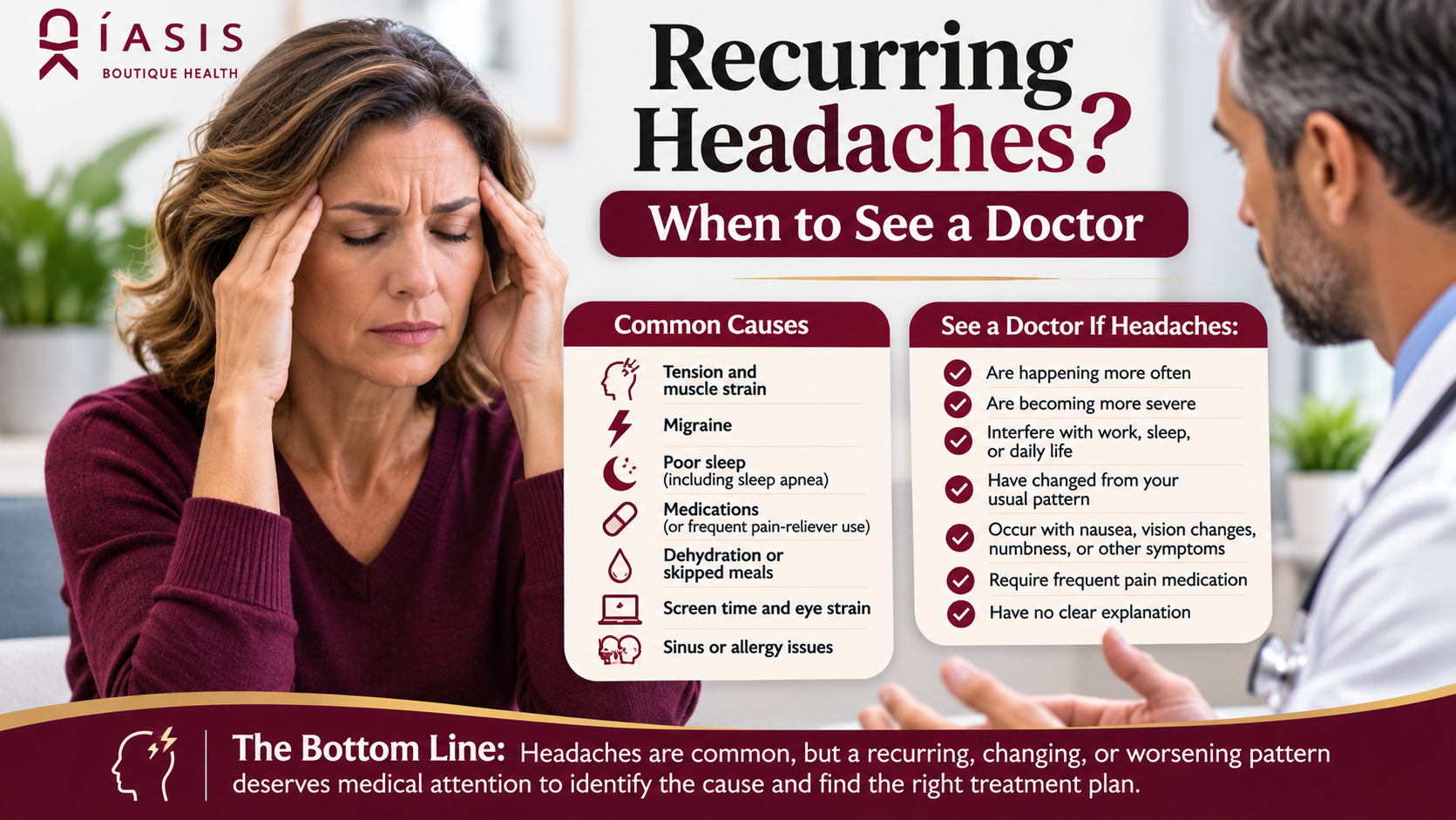
Recurring headaches can have many possible causes.
Depending on the pattern, your physician may consider:
- tension-type headaches
- migraine
- sleep problems
- dehydration
- caffeine
- stress
- eye strain
- neck or muscle tension
- medications
- frequent pain-reliever use
- other medical causes
The exact pattern often provides more useful information than the word “headache” alone.
When Should You See a Doctor for Headaches?
Schedule a medical evaluation when headaches:
- are happening more often than before
- are becoming more severe
- interfere with work, sleep, or daily activities
- require frequent pain medication
- have changed in location or character
- are associated with nausea, vision changes, numbness, or other symptoms
- have no clear explanation
You do not need to wait until headaches become unbearable before discussing a recurring pattern with your physician.
When Is a Headache an Emergency?
Seek urgent or emergency medical evaluation for a headache that is:
- sudden and extremely severe
- associated with new weakness or numbness
- associated with difficulty speaking
- associated with new confusion
- associated with fainting
- associated with severe difficulty walking
- associated with major vision loss
- associated with severe illness or rapidly worsening symptoms
Call 911 when stroke, a serious neurological event, or another medical emergency may be possible.
What Does a Tension Headache Feel Like?
Tension-type headaches are often described as:
- pressure
- tightness
- a band around the head
- pain around the temples
- pain in the back of the head or neck
Muscle tension, stress, posture, and long periods of computer work may contribute in some people.
These headaches may be uncomfortable without producing the classic symptoms associated with migraine.
What Does a Migraine Feel Like?
Migraine can look different from person to person.
Symptoms may include:
- moderate or severe head pain
- throbbing or pulsating pain
- pain that is worse with activity
- nausea
- sensitivity to light
- sensitivity to sound
Some patients also experience an aura before or during a migraine.
What Is a Migraine Aura?
A migraine aura may involve temporary neurological symptoms such as:
- flashing lights
- zigzag lines
- blind spots
- tingling
- other sensory changes
Because some neurological emergencies can also cause visual or sensory symptoms, new or unusual symptoms should be evaluated rather than automatically assumed to be migraine.
Can Stress Cause Headaches?
Yes.
Stress may contribute to muscle tension, poor sleep, changes in caffeine use, skipped meals, and other behaviors that can trigger headaches.
But repeated headaches should not automatically be dismissed as stress if the pattern is new or changing.
Can Poor Sleep Cause Headaches?
Yes.
Both insufficient sleep and disrupted sleep can contribute to headaches in some people.
Tell your physician if headaches occur with:
- frequent nighttime waking
- loud snoring
- morning fatigue
- daytime sleepiness
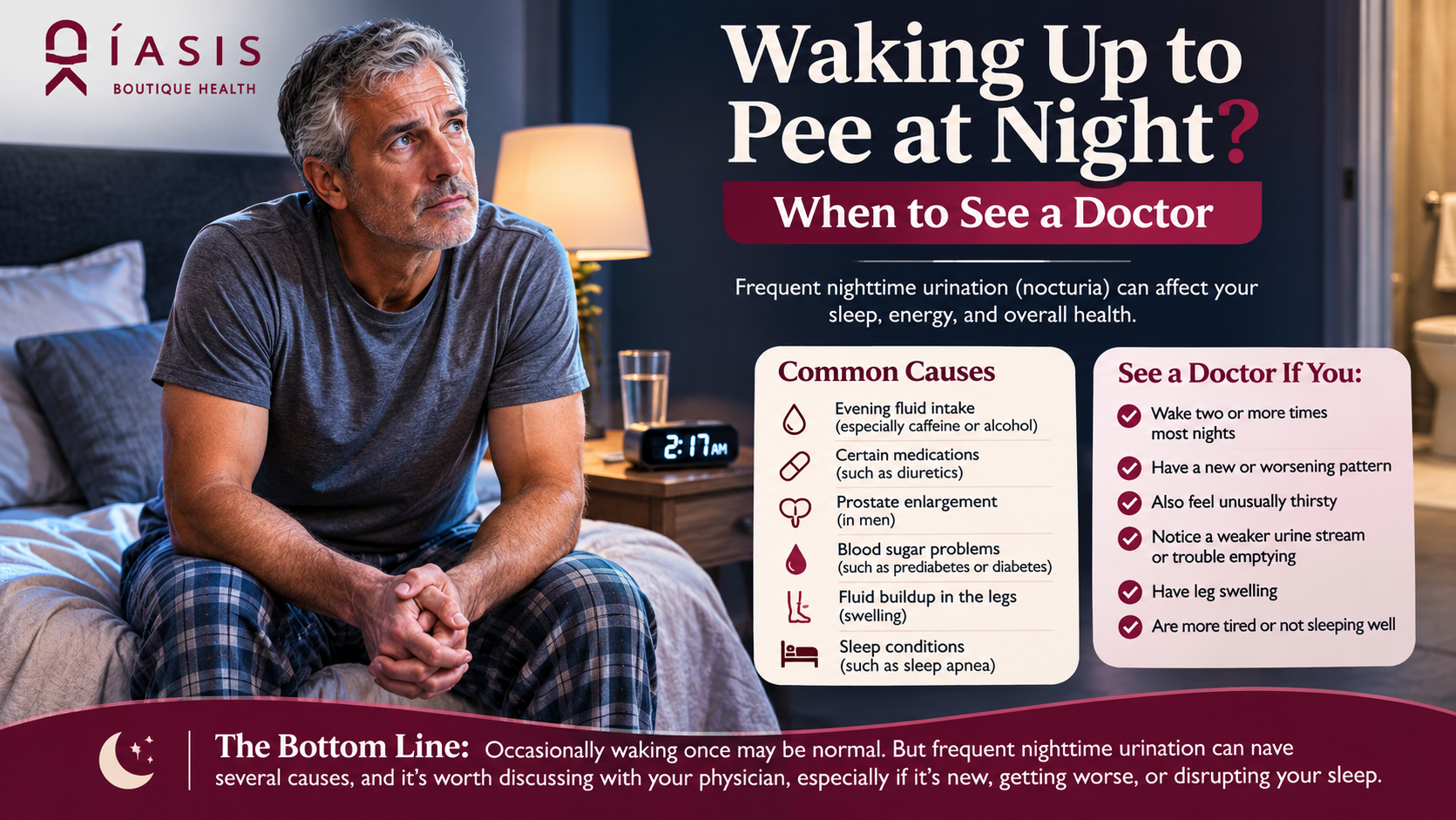
If you are repeatedly waking during the night to urinate, that sleep disruption can also be important context. Read why frequent nighttime urination may deserve medical evaluation.
Why Do I Wake Up With a Headache?
Morning headaches can have several possible explanations.
Your physician may consider:
- poor sleep quality
- sleep apnea
- teeth grinding
- medication effects
- caffeine withdrawal
- other causes
The pattern matters.
Tell your doctor whether the headache begins immediately on waking and whether it improves later in the day.
Can Sleep Apnea Cause Morning Headaches?
It can be associated with morning headaches in some patients.
Tell your physician if morning headaches occur with:
- loud snoring
- witnessed pauses in breathing
- gasping during sleep
- dry mouth
- daytime sleepiness
Can Dehydration Cause a Headache?
Yes.
Inadequate fluid intake may contribute to headaches in some people.
This may be more likely after:
- heavy exercise
- significant sweating
- illness
- vomiting or diarrhea
If headaches repeatedly improve after hydration, that pattern is useful to notice.
But persistent headaches should not always be attributed to dehydration.
Can Skipping Meals Cause Headaches?
It can.
Long periods without eating may trigger headaches in some people.
Try to notice whether symptoms occur:
- late in the morning
- before lunch
- after skipping breakfast
- during long workdays without regular meals
The timing may reveal a pattern.
Can Blood Sugar Problems Cause Headaches?
Changes in blood sugar can sometimes contribute to headaches or other symptoms.
But headaches alone do not diagnose a glucose problem.
Your physician may consider blood sugar when headaches occur with:
- increased thirst
- frequent urination
- fatigue
- shakiness
- known diabetes or prediabetes
If you recently had an elevated A1C, read what to do after being told you have prediabetes.
Can Caffeine Cause Headaches?
Yes.
Both caffeine intake and caffeine withdrawal can affect headaches.
If you regularly drink coffee or energy drinks, tell your physician:
- how much you consume
- what time you consume it
- whether headaches occur when you skip it
Sudden large changes in caffeine intake may be more noticeable than a stable routine.
Can Too Much Screen Time Cause Headaches?
Long periods of screen use may contribute to:
- eye strain
- neck tension
- poor posture
- fatigue
These factors can trigger headaches in some people.
If headaches mainly occur after computer work, tell your physician about that pattern.
Can Poor Vision Cause Headaches?
Uncorrected or changing vision can contribute to eye strain and headaches in some patients.
Tell your physician if headaches occur with:
- blurred vision
- squinting
- difficulty reading
- eye strain
An eye examination may sometimes be appropriate.
Can Neck Problems Cause Headaches?
Yes.
Muscle tension or certain neck problems can contribute to pain that extends toward the back or sides of the head.
Tell your physician if the headache occurs with:
- neck stiffness
- shoulder tension
- pain after prolonged sitting
- pain with certain neck movements
Why Do I Get a Headache After Working at My Desk All Day?
This pattern may involve several factors at once:
- poor posture
- neck tension
- screen strain
- stress
- dehydration
- missed meals
Tracking what happens during the hours before a headache can be useful.
Can Sinus Problems Cause Headaches?
Sinus infections or inflammation can sometimes cause facial pressure and head discomfort.
Symptoms may include:
- nasal congestion
- facial pressure
- nasal discharge
- reduced smell
However, not every headache around the forehead or face is caused by the sinuses.
What If I Keep Calling Every Headache a Sinus Headache?
Tell your physician exactly what the pain feels like and what other symptoms occur.
Some headaches that patients assume are sinus-related may actually fit another headache pattern.
A more detailed history can help distinguish them.
Can Allergies Cause Headaches?
Allergies may contribute indirectly through congestion, poor sleep, or sinus pressure in some patients.
But recurrent headache should not automatically be attributed to allergies without considering the full pattern.
Can High Blood Pressure Cause Headaches?
Routine high blood pressure usually does not cause obvious headache symptoms.
Very severe blood-pressure elevation can occur with symptoms and may require urgent evaluation.
If you have a headache and see a high home reading, do not assume the blood pressure is always the cause.
The headache, blood pressure level, and other symptoms should be considered together.
Should You Check Your Blood Pressure During a Headache?
If you already have a home blood-pressure monitor and can check it correctly, the reading may provide useful information.
Do not repeatedly check every few minutes out of anxiety.
One reliable measurement and the associated symptoms are generally more useful than constant rechecking.
Can Medications Cause Headaches?
Yes.
Headache may occur as a side effect of certain medications.
If recurring headaches began shortly after:
- starting a medication
- increasing a dose
- changing several prescriptions
tell your physician.
Do not stop an important prescription on your own.
If you take several medications, read what to ask your doctor when your medication list keeps getting longer.
Can Taking Too Much Headache Medicine Actually Cause More Headaches?
Yes.
Frequent use of certain pain-relieving medications can contribute to medication-overuse headaches in some people.
This can create a frustrating cycle:
You get a headache.
You take medication.
The headache improves temporarily.
Then headaches become increasingly frequent.
Tell your physician how often you take over-the-counter or prescription headache medication.
How Often Is Too Often to Take Pain Medicine?
The answer depends on the medication and the type of headache.
Rather than guessing, tell your physician:
- which medication you take
- the dose
- how many days per week you use it
If you need pain medication repeatedly just to function, the underlying headache pattern deserves evaluation.
What If the Headache Is Always on One Side?
One-sided pain can occur with migraine and other headache types.
Location alone does not establish the diagnosis.
Your physician will also consider:
- duration
- severity
- nausea
- light sensitivity
- eye symptoms
- neurological symptoms
What If the Pain Is Behind One Eye?
Headache around or behind the eye can have several causes.
Seek prompt evaluation if pain is accompanied by:
- significant vision changes
- a very red painful eye
- new neurological symptoms
- severe or rapidly worsening pain
What If My Headache Is in the Back of My Head?
Pain at the back of the head may occur with tension, neck problems, or other headache patterns.
Tell your physician if it is associated with:
- neck pain
- limited neck movement
- recent injury
- neurological symptoms
What If My Headaches Happen Around the Same Time Every Day?
Timing can provide useful clues.
Consider whether the headache occurs:
- before your morning caffeine
- after several hours at a computer
- when you skip lunch
- after work
- after exercise
A consistent schedule may help reveal a trigger.
What If Exercise Triggers My Headache?
Tell your physician.
Headaches associated with exertion deserve evaluation, particularly if they are:
- new
- sudden
- severe
- associated with dizziness, fainting, chest pain, or neurological symptoms
What If I Get Headaches With Dizziness?
Mention both symptoms.
Dizziness can have many causes and may or may not be directly related to the headache.
If dizziness is recurring, read when dizziness or lightheadedness should be evaluated.
What If Headaches Come With Numbness or Tingling?
This combination needs context.
Some migraine patterns can involve sensory symptoms.
But sudden numbness or weakness can also signal a neurological emergency.
New or unusual neurological symptoms should be evaluated promptly.
If numbness also occurs independently, read when recurring numbness and tingling should be checked by a doctor.
What If I Get Headaches With Nausea?
Nausea commonly occurs with migraine but can also happen with other illnesses or severe pain.
Tell your physician whether you also have:
- light sensitivity
- sound sensitivity
- vomiting
- visual symptoms
What If I Vomit With a Headache?
Repeated vomiting, inability to keep fluids down, a new severe headache, or vomiting with neurological symptoms deserves prompt evaluation.
The urgency depends on the severity and overall pattern.
What If My Headaches Have Changed?
A changing pattern is important.
Tell your physician if headaches are:
- more frequent
- more severe
- lasting longer
- appearing in a new location
- associated with new symptoms
Changes from your normal pattern may matter more than the absolute pain score.
What If I Have Had Headaches for Years?
A long-standing stable pattern may be less concerning than a new one, but frequent headaches can still affect quality of life.
If headaches interfere with work, family life, exercise, or sleep, there may be value in reviewing prevention and treatment options.
What If I Suddenly Start Getting Headaches Later in Life?
A new headache pattern later in adulthood deserves medical evaluation.
Your physician will consider:
- age
- medical history
- medications
- neurological symptoms
- other health changes
Do not simply assume a completely new headache pattern is “just migraine” without discussing it.
Can Headaches Be Related to Unintentional Weight Loss?
Headaches and weight loss can occur for unrelated reasons, but multiple new symptoms should be considered together.
If you are losing weight without trying, read when unexplained weight loss should be evaluated.
Should You Keep a Headache Diary?
Yes, this can be useful.
Track:
- the date and time
- how long the headache lasts
- where the pain occurs
- severity
- possible triggers
- sleep
- meals
- caffeine
- medications taken
- other symptoms
You do not need an elaborate spreadsheet.
A simple pattern over a few weeks can provide valuable information.
What Will Your Doctor Ask About Recurring Headaches?
Your physician may ask:
- When did the headaches begin?
- How often do they occur?
- How long do they last?
- Where is the pain?
- What does the pain feel like?
- Do you have nausea?
- Are you sensitive to light or sound?
- Do you have vision changes?
- Do you have numbness or weakness?
- What medications do you take?
The history is often one of the most important parts of headache evaluation.
What Will Your Doctor Look for During the Examination?
Depending on the situation, the examination may include:
- blood pressure
- neurological function
- strength
- sensation
- coordination
- eye findings
- neck movement
Do You Need Blood Tests for Headaches?
Not everyone does.
Blood testing may be considered when the history suggests another condition may be contributing.
Examples could include concerns involving:
- anemia
- blood sugar
- thyroid function
- other targeted issues
Testing should answer a medical question rather than be ordered automatically for every headache.
Do You Need an MRI or CT Scan for Recurring Headaches?
Not every patient with headaches needs brain imaging.
Imaging may be appropriate when the history or examination raises concern about a secondary cause.
Factors that may influence the decision include:
- a sudden severe headache
- new neurological findings
- a major change in headache pattern
- certain medical-history factors
Your physician can determine whether imaging is actually necessary.
Why Isn't More Testing Always Better?
Testing is most useful when there is a clear question it is intended to answer.
An extensive workup is not automatically appropriate for every recurring headache.
Your physician should first understand:
- the headache pattern
- associated symptoms
- the examination
- what has already been evaluated
If you have already had repeated testing without understanding what happens next, read what to do when you keep getting medical tests but still do not have a clear answer.
Do You Need a Neurologist for Headaches?
Not automatically.
Primary care or internal medicine can often begin the evaluation of recurring headaches.
A neurologist may be appropriate when:
- the diagnosis is unclear
- headaches are difficult to control
- neurological symptoms are present
- specialized treatment is needed
If you are unsure where to start, read Primary Care Doctor vs. Specialist.
What If a Specialist Sends Me Back to Primary Care?
That does not necessarily mean nothing is wrong.
It may mean that dangerous neurological causes have become less likely and ongoing management can continue through primary care.
Your PCP may then focus on:
- triggers
- medication use
- blood pressure
- sleep
- other medical contributors
If this happens, read what follow-up with primary care means after a specialist visit.
What If My Tests Are Normal but the Headaches Continue?
Follow up.
Normal testing can be reassuring without necessarily eliminating the need for headache management.
Your physician may need to reconsider:
- migraine
- tension-type headaches
- medication overuse
- sleep
- caffeine
- neck tension
- other triggers
What Questions Should You Ask Your Doctor?
Consider asking:
- What type of headache does this pattern resemble?
- Could one of my medications be contributing?
- Am I taking pain medication too frequently?
- Do I need blood tests?
- Do I need imaging?
- Could sleep be contributing?
- Should I see a neurologist?
- What symptoms should send me to the emergency room?
Why Continuity Matters With Recurring Headaches
Headache patterns often become clearer over time.
An established physician may be able to compare:
- previous headache frequency
- blood pressure trends
- medication changes
- sleep problems
- neurological symptoms
- previous testing
This longitudinal view can be more useful than treating each headache as an isolated event.
This is part of adult primary care in Orland Park.
How IASIS Boutique Health Approaches Recurring Headaches
At IASIS Boutique Health in Orland Park, Georgios Karanastasis, MD, provides membership-based adult primary care and internal medicine through a limited-panel practice.
When a patient reports recurring headaches, the goal is not to assume every headache is migraine, stress, or dehydration.
The pattern needs context.
Depending on the individual situation, that may include reviewing:
- headache frequency
- location and severity
- associated symptoms
- sleep
- caffeine
- medications
- blood pressure
- neck symptoms
- previous testing
Testing, treatment, or specialist referral can then be considered based on what the history and examination suggest.
For adults who want more time to evaluate recurring symptoms and understand the broader picture, learn more about internal medicine in Orland Park and concierge primary care at IASIS Boutique Health.
Frequently Asked Questions
When should I worry about recurring headaches?
See your physician when headaches are increasing in frequency or severity, interfering with daily life, changing from your usual pattern, or occurring with new neurological or other concerning symptoms.
Can stress cause daily headaches?
Stress can contribute to recurring headaches, particularly through muscle tension, sleep disruption, and changes in routine. Frequent headaches should still be evaluated rather than automatically attributed to stress.
Can dehydration cause headaches every day?
Dehydration can contribute to headaches, but daily headaches should not automatically be assumed to result from inadequate fluids without considering other causes.
Can high blood pressure cause headaches?
Routine hypertension usually does not cause obvious headaches, although severely elevated blood pressure may occur with symptoms and requires appropriate evaluation.
Can lack of sleep cause headaches?
Yes. Poor or fragmented sleep can trigger headaches in some patients. Morning headaches may also raise questions about sleep apnea or other sleep problems.
When is a headache an emergency?
Seek emergency care for a sudden extremely severe headache or a headache accompanied by new weakness, numbness, difficulty speaking, confusion, fainting, major vision changes, or other severe neurological symptoms.
Do I need an MRI for recurring headaches?
Not necessarily. Imaging is usually based on the headache pattern, examination, neurological symptoms, and other risk factors rather than ordered for every recurring headache.
Should I see a neurologist for headaches?
Not always. Primary care or internal medicine can often begin the evaluation. Neurology may be appropriate for difficult-to-control headaches, unusual patterns, or neurological symptoms.
What should I track in a headache diary?
Track when the headache occurs, how long it lasts, where the pain is located, possible triggers, sleep, meals, caffeine, medication use, and other symptoms.
The Bottom Line
Headaches are common.
But recurring headaches deserve more attention when the pattern changes.
Ask:
How often are they happening?
Are they getting worse?
Where is the pain?
How long does it last?
What triggers it?
Am I taking pain medicine frequently?
Are there neurological symptoms?
Is this different from my usual headache?
The goal is not to assume the worst or order every possible test.
It is to understand the pattern well enough to identify the likely type of headache, rule out concerning causes when appropriate, and create a practical treatment and follow-up plan.
At IASIS Boutique Health, Dr. Georgios Karanastasis provides adult primary care in Orland Park through a limited-panel membership model centered on longer appointments, continuity, direct physician communication, preventive care, and thoughtful evaluation of recurring health concerns.
About the Author
Georgios Karanastasis, MD is a board-certified internal medicine physician and founder of IASIS Boutique Health in Orland Park, Illinois. He earned his medical degree from the University of Athens in Greece and completed his internal medicine residency at John H. Stroger Jr. Hospital of Cook County.
Dr. Karanastasis provides adult primary care with a focus on preventive medicine, cardiovascular health, medication management, chronic disease management, and long-term physician-patient relationships.
Through IASIS Boutique Health, he provides membership-based care through a limited-panel practice designed to allow longer appointments, direct physician communication, continuity, and more time to understand each patient's broader health picture.
Medical Review: Georgios Karanastasis, MD
Last Reviewed: November 16, 2026
Medical Disclaimer
This article is intended for general educational purposes only and does not replace individualized medical advice, diagnosis, or treatment. Headaches have many possible causes, and the appropriate evaluation depends on the pattern, associated symptoms, medications, medical history, examination, and individual risk factors. Seek urgent or emergency medical care for a sudden severe headache, new neurological symptoms, fainting, major vision changes, or other severe or rapidly worsening symptoms.
Related posts
iasiscare I Keep Feeling Dizzy or Lightheaded—When Should I See a Doctor? iasiscare
My Hands or Feet Keep Going Numb or Tingling—When Should I See a Doctor?
 iasiscare
Why Are My Ankles or Feet Swollen—and When Should I See a Doctor?
 iasiscare
Why Am I Bruising So Easily All of a Sudden?
 iasiscare
Why Am I Getting Short of Breath Doing Things That Used to Be Easy?
 iasiscare
Why Do I Keep Waking Up to Pee at Night?